
I Felt Like a DC VIP on a Behind-the-Scenes Capitol and Library of Congress Tour


“You have to remember that the city was built on a swamp,” our tour guide Kirsten tells our small group of 15 as we stand outside the Court of Neptune Fountain, right in the middle of Washington DC. We all chuckle in response. Today, we don’t need the reminder.
It’s the day after the Fourth of July in the nation’s capital, and even though it’s only 9am, the morning is already heavy with heat and humidity. My smartphone registers the temperature as a balmy 92°F (33°C); by the time our tour finishes three hours later, the thermostat will have cracked 100°F (38°C).
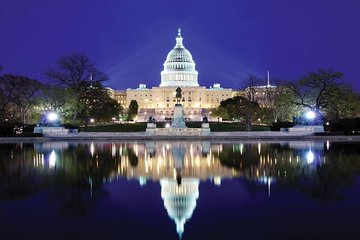
None of this is new to me: not the awe-inspiring summer heat, nor the equally extraordinary tableau of landmarks before us. There, the steps of the Supreme Court; behind us, the grand entrance of the Library of Congress’ Jefferson Building; in front, the iconic point of the U.S. Capitol’s skyline-cresting dome. My extended family lives in Washington DC, and I’ve visited the city, and seen its major monuments, more times than I can count.
But what’s coming next is genuinely new. Our group won’t just be wandering on foot outside these world-famous government icons. Soon, we’ll be heading right inside the Capitol—entering not just into the heart of one of the world’s best-known buildings, but right into the belly of American democracy.
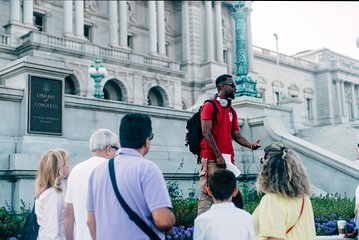
But we have to build up to that big reveal. First, it’s time for a brief walking tour. As Kirsten takes us around the block, she provides us with a crash course in Washington DC’s history ideal for first timer’s and even regulars, like myself—how the capital was situated in this unlikely, boggy setting along the Potomac River as a compromise between states; how, like all construction projects, it ran massively over budget and behind schedule; how the Capitol-in-progress was partially destroyed during the War of 1812 (well, technically in 1814) and had to begin again.
It’s a wealth of historical background, but Kirsten’s pacey, humorous storytelling keeps it lighthearted and keeps us moving despite the heat. Still, we’re all relieved when, after 30 minutes of exploring on foot, we approach the Capitol’s Visitor Center and the sweet prospect of air-conditioning. But before we head inside, Kirsten draws our attention to one final detail: the figure standing atop the Capitol’s cast-iron dome. It’s the 19-foot-high (5.8-meter-high) Statue of Freedom, she says, crowned with her distinctive feathered headdress.
It turns out that Freedom is only one among dozens of statues we’ll see during the tour (not including her plaster double, located within the Capitol’s Emancipation Hall). But first, once our group passes through the airport-style security, we grab headsets and audio guides and say goodbye to Kirsten; a dedicated Capitol tour guide will lead us through this portion of the tour.

We begin by finding seats in a dark, movie theater–style room. The 15-minute introductory film we watch offers a stirring history of the Capitol, the American Revolutionary War, and the Connecticut Compromise, which established a bicameral legislative branch, a Congress divided between House of Representatives and Senate. While we won’t be going into either chamber today, it’s the first moment when I really feel just how close I’m sitting to something ineffable—to the weight of history, and power accrued over centuries.
The experience puts me in a reflective mood as we continue deeper into the building. Our first stop, the Capitol Crypt, looks unremarkable at first. It’s a relatively spartan space, filled with 40 sandstone columns. The room had once been intended for President George Washington’s tomb, but that plan never came to fruition; a compass stone marking the central dividing point of the city now occupies that unfilled spot. As for those columns, they have the extraordinary task of supporting the building, and the staggering 4,500-ton (4,500,000-kilogram) weight of the Capitol’s cast-iron dome. At our guide’s encouragement, we notice the grooves and patterns in their surface—evidence of their sculpting, and of the enslaved people who built so much of the city. It’s a masterclass in architecture and history rolled into one.
With that somber context in mind, we ascend the stairs and head straight into the Capitol’s crowning glory: the Rotunda. Designed after the Roman Pantheon, the soaring space is so large it feels impossible to take in all at once—and it’s a must for art-lovers. There is the central fresco featuring George Washington ascending to heaven. (“He would have hated that,” our tour guide laughingly acknowledges; apparently Washington was uncomfortable with all the adulation.) There is the painted, trompe-l’oeil frieze, which tells the story of American history from the colonial era to the age of aviation. And there are the eight larger-than-life paintings depicting other idealized moments in the country’s early history.

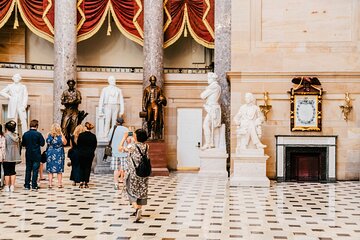
After drinking in the spectacle, we head into our last stop in the Capitol: the National Statuary Hall. The space, formerly the Old Hall of the House, once contained the House of Representatives, and little plaques on the floor mark where early statesmen sat. But after they moved into their current wing in 1857, it was turned into an art gallery, and each state was invited by Congress to contribute two marble or bronze statues of prominent citizens.
Although the National Statuary Hall Collection later outgrew the space, and has since spread around the building, the room still contains 38 statues today. Alongside the expected US political leaders, we also spot figures like Amelia Earhart, Thomas Edison, and Chief Standing Bear.
As our time at the Capitol comes to an end, our group says goodbye to our in-house tour guide and reconnects with Kirsten. It already feels like I’ve digested more history per square inch than my brain can quite process. I almost forget that the tour isn’t even over yet: We still have to head to the Library of Congress. Luckily for us, underground tunnels lead us straight there, and we don’t have to worry about braving the late-morning heat just yet.

As we walk into the landmark’s main entry hall, I find myself staggered anew. The building is unbelievably opulent and decorative, every surface seemingly covered in vibrant frescoes, bronze statues, golden lanterns, and other ornate details. The beaux-arts building was inspired by Paris’ Opéra Garnier and completed during the Gilded Age, Kirsten tells us, and again we chuckle at the unsurprising update. She points out a copy of the Gutenberg Bible, safely protected in its own climate-controlled display area, and then we’re off to discover the heart of the collection: Thomas Jefferson’s Library.
When the Library of Congress was burned by the British in 1814, its collection was lost. Meanwhile, Kirsten says wryly, Thomas Jefferson was a voracious reader with a book-hoarding problem, not to mention a mountain of debt. And so it seemed a natural solution for Jefferson to sell his books to Congress to start the new Library of Congress collection, and many are still on display today. It’s moving to look at those books with the knowledge that the Library of Congress has since grown into the largest library in the world.

Next, although we can’t enter the Main Reading Room at the heart of the library—it’s only accessible to scholars and researchers—we can look down into the space from the mezzanine level. The reader and writer in me feels a pang of envy: What would it be like to work in such a beautiful, history-saturated space?
There’s no time for further reverie, though. The clock strikes 12, and with that, our morning tour has come to a close. Still, Kirsten tells us, we can linger in the library longer if we wish. I take one look at the temperature and make my decision: Yes, I’ll stay a while longer.
This tour was provided courtesy of Viator.
More ways to explore Washington DC







Keep reading


