
Franciscan Friar Jacopo Pozzerle’s Guide to Rome


After a childhood of fascination with Saint Francis, Jacopo Pozzerle became a Franciscan friar at the age of 23. This career brought him to Rome, Italy, where the Catholic Church operates from the Vatican: an independent state in the heart of the city. Over his decades of service, Pozzerle developed a deep understanding of Rome—and how visitors can experience its hidden gems.
As a Franciscan brother, Pozzerle lives by a specific code. “A monk makes a vow of stability. They enter that place and they live all their life in a monastery,” he says. Pozzerle explains that Saint Francis introduced a different approach. “Saint Francis started what we call the friars, the brothers,” he says, “which is a bit different. Brothers live a prayerful life, but also they mingle with people.”
Deeply embedded within the local community, Pozzerle has a distinct perspective on Rome travel tips—and after years as a bona fide Roman, here is his local guide to Rome.
What to see and do in Rome

According to Pozzerle, some of the best things to do in Rome are free. “You can access churches for free,” he says, “and on the first Sunday of the month, some museums have free entry.”
For religious artwork, churches are some of Rome’s best hidden gems. Pozzerle highlights Michelangelo’s Moses, displayed in the Basilica of San Pietro in Vincoli. He also recommends the Basilica of San Clemente, San Luigi dei Francesi, and Santa Maria in Trastevere.
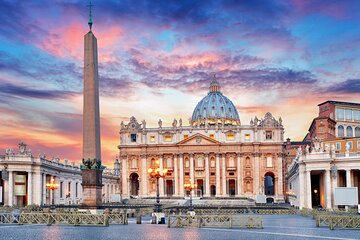
The Vatican Museums and Sistine Chapel are nonnegotiable in any Rome travel guide. However, Pozzerle suggests adding a visit to the underground St. Peter’s tomb.
After finding an inscription reading: “Peter is here,” the Church believes that St. Peter was crucified on Vatican Hill. “One thing that I find interesting archaeologically is the excavations under the Vatican,” he says. “You enter an underground graveyard with Roman and Christian tombs and the place where, allegedly, St. Peter was buried.”
Pozzerle says not to skip a Colosseum tour. However, to learn more about Rome’s Christian history, he recommends the Catacombs of St. Sebastian.
Where to stay in Rome

Of all the best neighborhoods in Rome, Pozzerle recommends Trastevere. “It’s a characteristic area; you have little restaurants and narrow roads,” he explains. “Trastevere as a neighborhood is very typical of the Rome city center.”
Located on the western bank of the River Tiber, it’s within walking distance of the Vatican. Public transport can be overwhelming in Rome for first-time visitors, but for religious sightseeing, Trastevere is a prime location.
On shaded afternoons, the neighborhood has leafy urban walks, including Villa Sciarra and Janiculum Hill viewpoint. There are also guided food tours in Trastevere or pasta and tiramisu-making classes.
Where to eat and drink in Rome

Knowing where to eat in Rome might be a mission for travelers, but Pozzerle knows where to look.
He recommends a reservation with “the singing sisters” at L'Eau Vive. “The restaurant is run by sisters, who with their earnings support missions,” he says. Pozzerle also points travelers towards La Trattoria degli Amici, a community initiative that hires staff with disabilities and translates as “the restaurant of friends.”
Every Rome food guide advises travelers to avoid touristy restaurants, but Pozzerle has straightforward advice.
“In Rome, you have plenty of stuff for tourists,” he says, “But it’s important to look for something small and typical.” According to Pozzerle, the word “trattoria” is a good clue—Italians rely on these casual restaurants for affordable and traditional cuisine.
Common mistakes when dining in Rome

“If you ask for an Americano, don't be disappointed if they kind of stare at you,” laughs Pozzerle. “For Italians, an Americano is just dirty water.”
When ordering coffee in Rome, local tips are essential to avoid confusion. “If you ask for latte in Italian, latte in Italian means milk, and so you’ll get a glass of milk,” he adds. “If you want a latte, you should ask for a latte macchiato, which means a latte with a spot of coffee.”
Pozzerle warns that some restaurants charge a cover charge (coperto) of a few euros. However, travelers shouldn’t worry about eating baskets of bread, which are typically complimentary. “It’s not common practice to leave tips,” he adds, “although the waiter, or waitress, will appreciate it, of course.”
Book more things to do in Rome




Keep planning your Rome trip


