
Know Before You Go: Visiting Mt. Rainier


At 14,410 feet (4,392 meters), Mt. Rainier is the tallest mountain in Washington, the highest volcano in the Lower 48, and it's situated in one of the most visited national parks in the US. By which we mean—it's popular. So, when visiting Mt. Rainier, know-before-you-go preparation matters deeply, as conditions change fast, crowds can be intense, and the park's size and scale can catch first timers off guard.
Whether you're planning a day trip from Seattle or a multi-day adventure, a little planning goes a long way. From entrance requirements to figuring out how to find the right trail for your group, here's what to know before you go.
When’s the best time to visit Mt. Rainier?

The best time of year to visit Mt. Rainier depends on what you're hoping to see—and how you feel about snow.
Mt. Rainier National Park is a year-round destination, but most visitors come between July and September, when the park is fully open, the wildflowers are blooming, and the trails are navigable at all elevations. As such, in the peak season from July through August, expect big crowds, full parking lots, and brilliant sunshine.
For a quieter visit with dramatic scenery, aim for September, when the huckleberries turn red and the crowds thin noticeably. Winter visitors can snowshoe and cross-country ski without the crowds, yes, but most facilities are closed, and road access is limited. (Only the Nisqually Entrance is open for vehicle access, allowing travel to Longmire and Paradise.)
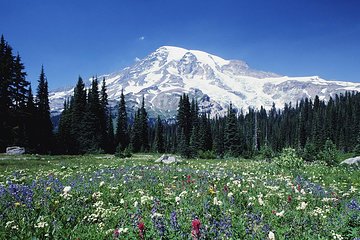
Insider tip: Looking for Mt. Rainier wildflower season information? Blooms typically peak from late July to mid-August, particularly along the Skyline Trail and in the Paradise area.
What are Mt. Rainier’s hours, and when should I arrive?

Arriving early is the single best strategy for a stress-free visit, especially in summer.
Mt. Rainier is technically open 24 hours a day, 365 days a year, but the best time to arrive depends on the season. To beat summer crowds—and the dreaded parking scramble—aim to arrive before 9am.
Any later than that, and your odds of nabbing an easy parking spot in popular areas including Paradise decrease significantly, and rangers may redirect your vehicle.
Insider tip: If you’re visiting in spring or fall, it’s still smart to arrive early, but you’ll face less competition along the roads and parking lots. With the sun rising later, you’ll stand a chance of catching those golden sunrise photos, too.
How do I get to Mt. Rainier from Seattle?

Knowing how to reach Mt. Rainier from Seattle helps you decide between driving, guided tours, and shuttles.
Mt. Rainier sits about 75 miles (120 kilometers) from downtown Seattle—it’s a drive of roughly two hours, depending on traffic and your chosen park entrance. The Nisqually Entrance (southwest) is the most popular, and it’s the only one open year-round.
No direct public transit serves the national park, but several operators offer guided day trips and shuttles from Seattle. Tours are a great option if you have concerns about driving conditions and road closures in Mt. Rainier, or if you’re simply looking for a Mt. Rainier photography and viewpoint guide.
What ticket and tour options are available for Mt. Rainier?

Skip delays and save money at the gate with these Mt. Rainier National Park tour options.
Entry to Mt. Rainier National Park requires a vehicle pass (US$35 per vehicle, valid for 7 days) or an individual pass (US$20 for pedestrians and cyclists). The America the Beautiful Annual Pass (US$80) covers entry to all federal lands for a full year and pays for itself after just two or three national park visits. Timed entry reservations are not currently required at Mt. Rainier, but this could change—check the park website before your visit.
As for guided experiences, there are a wide range of options, from full-day guided hikes to Seattle day-trip packages that handle all the logistics for you, sometimes including parking and entrance fees. If you can’t make it to the park itself, book a boat tour on Puget Sound with a scenic view of the mountain.


Where are the best photography spots and hiking trails at Mt. Rainier?

There’s no wrong answer, but Reflection Lakes and Paradise are hard to beat.
While Mt. Rainier has no bad side, Reflection Lakes produces the famed mirror image of the mountain on calm mornings—arrive early for the glassiest conditions. For blooms, Tipsoo Lake is spectacular during wildflower season, and it’s less crowded than Paradise (though Paradise is great, too).
As for Mt. Rainier day hike recommendations, the park has more than 260 miles (418 kilometers) of maintained trails, so the challenge is narrowing things down. For first timers, the Skyline Trail Loop (moderate) at Paradise offers wildflowers, glacier views, and the full Rainier experience. For family-friendly trails in Mt. Rainier, Paradise’s Nisqually Vista Trail is accessible from the Henry M. Jackson Visitor Center—great for younger hikers.
What should I wear and bring to Mt. Rainier?

Layering is non-negotiable at Mt. Rainier, as temperatures and weather can shift dramatically within a single day.
Even in June, temperatures at Paradise (elevation 5,400 feet or 1,645 meters) can drop to near-freezing, and afternoon thunderstorms are common throughout summer. Dress in moisture-wicking base layers and bring a waterproof shell—no exceptions. Sturdy, broken-in hiking shoes or boots are essential, too.
Beyond clothing, pack a reusable water bottle , sunscreen and sunglasses (UV exposure is intense at elevation), a hat, trail snacks, a paper or downloaded map, and a small first-aid kit. Bear canisters are not required in day-use areas, but they are recommended for backpackers with overnight permits.
Is Mt. Rainier accessible for wheelchair users and people with disabilities?

Mt. Rainier offers meaningful accessibility options, though the rugged terrain means advance research is essential.
Though largely rugged and wild, Mt. Rainier has a few spots that are good for those with mobility issues. The Myrtle Falls Trail (1 mile or 1.6 kilometers round-trip) is paved and suitable for wheelchairs with help and strollers, and half of the Trail of the Shadows (0.3 miles or 0.5 kilometers) is wheelchair accessible.
The America the Beautiful Access Pass is also available free of charge to US citizens and permanent residents with permanent disabilities and covers entrance fees.
Insider tip: Accessible restrooms can be found at visitor centers and at popular picnic areas with good infrastructure, such as the Paradise Picnic Area.
Where should I stay on my Mt. Rainier trip?

Where to stay near Mt. Rainier National Park depends on how much access, solitude, and comfort you're after.
Near Mt. Rainier, lodging options range from rustic to elegant. Inside the park, the historic Paradise Inn (open late May through early October) offers a classic mountain-lodge atmosphere steps from the best trails—book this one months in advance, as it fills up fast. The National Park Inn at Longmire is open year-round and offers a quieter, more intimate base.
For camping, Cougar Rock and Ohanapecosh campgrounds are the most accessible; reservations go quickly, so even campers need to plan. Outside the park, the towns of Ashford, Packwood, and Enumclaw offer vacation rentals, B&Bs, and small motels if you'd prefer to stay beyond the park and drive in.
Frequently asked questions

Everything you need to know about visiting Mt. Rainier.
- Can I climb to the summit of Mt. Rainier? Technically, yes, but it's a serious mountaineering trek, not a hike. Summit attempts require permits, lots of technical gear, and significant experience with heavily glaciated terrain.
- Is there cell service inside Mt. Rainier National Park? Cell service is limited throughout the park. Download offline maps (such as the NPS app or Gaia GPS) before you arrive, and don't plan to rely on navigation apps once you're there.
- Can I bring my dog to Mt. Rainier? Dogs are technically allowed in parking lots and campgrounds, but they are not permitted on trails, in wilderness areas, or in park buildings. All pets must be on a leash at all times.
- Are there bears in the park? Yes, Mt. Rainier is home to black bears. Store all food and scented items in bear boxes or approved canisters, and never approach or feed wildlife, bears or otherwise.
Book more things to do in Seattle





Keep planning your Seattle trip


