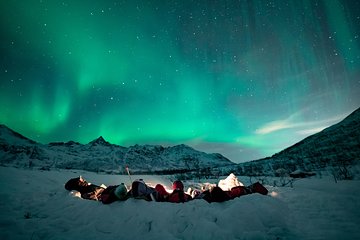
Rather Than Chase the Northern Lights, Let Them Find You


So many times, as travelers, we venture somewhere, mind and heart focused on what we believe we will certainly see when we arrive. Those fixtures—like the Eiffel Tower, Machu Picchu, the Grand Canyon—make up the mosaic of a trip and are, whether we admit it or not, often the whole point of a journey. But when seeing the northern lights is your travel mission, catastrophic disappointment is as likely as utter elation.
When “hunting” for the northern lights, I’ve learned—after many attempts to see them, much failure, and a few precious and unforgettable wins—that the best thing to do is to let go of all expectations and just go along for the ride. Because, if there is any travel moment that chooses you, more than the other way around, it is the northern lights.
Some years ago, on a dark late-August evening offshore from Tromsø, in Northern Norway, I was alone on watch at the helm of a 37-foot (11-meter) sailboat, Barba, cruising through islands just north of the Arctic Circle while the other four members in our expedition slept below deck.
Our international crew had just spent several months on an epic adventure during which we had circumnavigated the arctic archipelago of Svalbard under the nonstop daylight of the midnight sun, staying up all night to spot polar bears and walrus and scuba diving beneath icebergs before sleeping all day, disoriented in the relentless brightness of the polar summer.
Finally, we had navigated back to the mainland’s lower latitudes for the long journey south before the season’s first snows, and the evenings had grown properly dark again. I was looking out for navigational markers between rocky islands, when what looked like a faint whitish-cloud hovering above the horizon suddenly rose in the sky at a rate far more rapid than clouds can move.

Just like that, the northern lights began to dance in shimmering green drapes. The show went on for hours. This was not my first time seeing the aurora borealis, but it was my first time watching the spectacle while wearing a t-shirt and standing in temperatures that weren’t even close to cold. I knew that it doesn’t have to be freezing cold outside for the northern lights to appear—it just has to be dark. Nonetheless, the moment had caught me entirely off guard, and the experience was all the more incredible for it.
Before that sighting, I had had the chance to “hunt” for the lights many times, and in some of the most beautiful places in the world. But when I was actually looking for them, they usually eluded me.
Related: Chasing the Aurora: Where to See the Northern Lights Around the World

My first time was on an official tour in Northern Norway, where the aurora appeared on the guide’s camera screen as glowing green smudges in the long-exposure shot but remained utterly invisible to our naked eyes. The guide kept pointing to white clouds at the horizon and then to his greenish camera screen, saying “It’s the aurora!” I tried to conceal my disappointment between the many layers of down and wool keeping my body warm.
A few years later, the northern lights had skunked me again when I stayed all night in Lapland; the perpetually snowy nights never granted me a break in the sky to see them. And on another clear, cold night outside the Icehotel in Kiruna, Sweden—when the conditions were said to be perfect and even the apps on our phones indicated a good chance for an aurora show—they remained elusive.
I was beginning to notice a pattern.
Every time I went out explicitly looking for the northern lights, they never appeared. And that made not seeing them all the more of a letdown.
So, I decided to stop expecting them.

By the time I came to this realization, I was addicted to the north and regularly returned to the world’s most beautiful Arctic landscapes. Those places were, of course, worth the journey on their own. They also happen to be where you can see the lights.
When the northern lights do finally decide to grace you with their proper presence—and that is exactly what they do, when they do it, they grace you—their shimmering green curtains or pinks and purples bruising the black sky can make your jaw drop open as if you’ve seen a ghost. You become a believer.
But the experience is not something you can script. Seeing the northern lights is quite simply about being in the right place at the right time. It could be during a window of several hours spent enjoying conversation with friends around a bonfire on an early autumn night in Alaska or a fortuitous 15-second pee break outside your tent in Lapland or northern Minnesota.
It all comes down to science and weather. To see the northern lights, which appear in the sky all year round, there must be solar activity on the surface of the sun. These solar storms, called solar flares, cause the often green (but potentially multi-colored) formations when highly charged electrons reach our upper atmosphere and are pushed toward the poles by the Earth’s magnetic field. The sky also has to be clear enough for you to see the show.
Related: 7 of the Best Places To See the Northern Lights in North America

During one of my most recent visits to Northern Norway, the year before the pandemic, I had convinced my entire extended family to pass on a Caribbean vacation for spring break in the Arctic. My sister, her husband, my four nieces, my kids, and my husband all made the trek from Tampa to the Lofoten Islands. I admit that I dangled the possibility of seeing the northern lights in front of my family in order to get them to commit.
We all stayed with my friend Hanna in her old wooden house near the cod fishing docks in Henningsvær. We were far enough north to see the northern lights when it was dark and clear out, but the weather wouldn’t cooperate. Instead, it proceeded to blizzard to near white-out conditions for the length of our week-long vacation. (“You should have been here last week,” everyone said.) We huddled inside the old creaking house as the winds howled day into night, playing cards and baking, sipping toddies, and trying to keep the disappointment of everything the weather might be hiding at bay.

On my last night, Hanna—who had seen the northern lights too many times to count but was also accustomed to them pulling their disappearing act whenever friends came looking for them from abroad—coaxed me out for a walk during a break in the wind. Her dog pulled us along the slick streets, toward a field caked with an icy layer of snow that crunched beneath our feet. The sky above us appeared to be clearing, and then, miraculously, it suddenly opened up.
It started as a smoke-like apparition, white and foggy as if puffing out from the sky’s own pipe. And then the aurora exploded like puncture wounds in the blankness around it, scrawling a glowing magenta and green script that could have been Arabic or Farsi in all its curls and flourishes. I had an urge to sprint the long mile back to the house to gather my friends and family who’d stayed behind. But 15 seconds or so later, it was gone. My heart pounded. The sky prickled with stars. The dog tugged on its leash. We walked on in silence.
Hanna gave me a knowing look. She had seen this movie before. If you don’t ask for it, it will come. I considered telling my family what they missed when I got back, but I didn’t. Their time would come, too.
Book more things to do in Norway


Keep planning your Norway trip