
7 Alternatives to America’s Most Popular National Parks


America’s national parks are busier than ever—visitation has increased by millions over recent years, with the majority of those visits concentrated in the 25 most popular parks. Though our increased appreciation for the outdoors is a good thing, responsible travelers know finding other, less-traveled destinations is better for the planet … and less time navigating parking lots means more time with Mother Nature.
The good news? Hundreds of lesser-known national and state parks offer incredible natural experiences away from the rows of brake lights and lines of visitors. We’ve narrowed it down to the best of the best—take a look.
1. Swap Yellowstone National Park for Custer State Park, South Dakota

For wildlife, you can't go wrong at South Dakota's underrated Custer State Park.
Wildlife lovers crowd into Yellowstone’s Lamar Valley nearly every morning searching for bears, wolves, and elk. Don’t follow them.
Instead, head to the rolling forests and granite peaks of South Dakota’s Custer State Park, one of the richest wildlife spots in the nation. Hop on the park’s 18-mile (29-kilometer) Wildlife Loop Road to admire pronghorn antelope, elk, mountain goats, prairie dogs, and one of the largest bison herds in the country. Make it a South Dakota discovery tour with stops at the nearby Mount Rushmore National Memorial and Crazy Horse Memorial, two of the largest mountain carvings in the world.
Insider tip: The wildlife here is so rich, you can expect to make the neck-craning drive at roughly 25 mph (40 kph).
2. Swap Joshua Tree for Pinnacles National Park, California

For desert scenery, Pinnacles is just as good (if not better) than Joshua Tree.
Just over six hours north of Joshua Tree, a new-ish addition to the National Park roster has yet to draw the spotlight: Pinnacles National Park. Similar to its southern sibling, Pinnacles offers golden volcanic landscapes full of chaparral, oak woodlands, canyon bottoms, and even talus caves and towering rock spires. Catch wild condors in the skies above Condor Gulch Overlook, bring a flashlight to wander inside the desert gulches and caves, and stay the night for some of the state’s best stargazing.
Related: 7 of the Best National Parks in the US for Stargazing
3. Swap Glacier for North Cascades National Park, Washington

For glacial lakes and peaks, Washington's North Cascades National Park has you covered.
With Glacier imposing vehicle reservations to mitigate traffic, now’s the time to head to Washington State’s North Cascades National Park instead. Believe it or not, this spot only receives roughly 30,000 visitors per year, so you’ll be kept in good company with the park’s 300+ glaciers, pine forests, neon-blue alpine lakes, and wild hiking trails. For something ultra-memorable, book a stay at the exclusive Ross Lake Resort to spend your nights in a floating cabin above the water. Bonus: It’s only a 3-hour drive from Seattle.
4. Swap Acadia National Park for Peninsula State Park, Wisconsin

For water views, go to Wisconsin's Peninsula State Park instead of Acadia.
As the crowds clamor to the top of Mt. Cadillac for sunrise, you’ll be enjoying those morning rays from a kayak off Peninsula State Park, in Wisconsin’s Door County. Here, a towering wall of limestone juts out from the center of Lake Michigan—it’s the same rock that Niagara Falls pours over, actually—making for incredibly scenic hiking, paddling, biking, and camping opportunities. Though covered in icicles and frost come winter, summer’s landscapes look practically Caribbean, as teal-blue waves crash against sandstone cliffs and evergreen forests.
5. Swap Arches National Park for Goblin Valley State Park, Utah

For red rocks, Goblin Valley State Park has fewer crowds and (arguably) better views than Arches.
You know about red-rock arches and hoodoos, but how about “goblins?” At Goblin Valley State Park, in Utah’s San Rafael Desert, the quirky word refers to the park’s wild rock formations—monstrous, hypnotic, and practically Martian. Hiking the “Goblin’s Lair” (it’s actually a slot canyon) or across the “First Valley of Goblins” makes for a wild story once back home, though canyoneering down the “Chamber of the Basilisk” may be the park’s truest action-flick-worthy adventure.
Insider tip: Goblin Valley State Park is also an International Dark Sky Park, so stick around to gaze into those cosmos after dark.
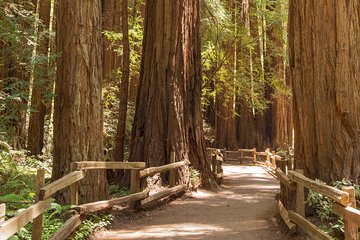
6. Swap Yosemite for Humboldt Redwoods State Park, California

For giant trees, *of course* a state park with "Redwoods" in the name is the place to be.
National parks aren’t the only places to see the tallest trees in the world. Old-growth redwood forest comprises one-third of the 53,000-acre (21,448-hectare) Humboldt Redwoods State Park—the largest expanse of ancient redwoods left on the planet. One of the most accessible spots in California’s North Coast region to see the trees’ majesty, simply hop in the car to journey the 32-mile-long (51-kilometer-long) Avenue of the Giants for a scenic ride like no other. Hiking, camping, fishing, swimming, and cycling are popular here, too.
7. Swap Rocky Mountain National Park for Chugach State Park, Alaska

For mountain views, get yourself to Chugach State Park.
Where Rocky Mountain National Park has timed entry, Chugach State Park—just 7 miles (11 kilometers) away from downtown Anchorage—has open landscapes for the taking. At 500,000 acres (202,343 hectares), it’s the third-largest state park in the country. The peaks of the Alaska Range, the Chugach, and the Wrangell Mountains bound the park on three sides, and the fourth? The waters of Prince William Sound. Here, 280+ miles (450+ kilometers) of maintained trails lead up to high mountain vistas, down to ocean waves, and approach massive glaciers and icefields. In other words: uncompromised, full-tilt Alaskan adventures await.
More ways to explore US National Parks




Keep reading


