
11 of the World's Most Awe-Inspiring Geological Wonders


With so much entertainment available at the touch of an app, we often forget how amazing this planet can be. But when you see the things like holes in the ocean, 30,000-foot-tall (9,144-meter-tall) mountains, armies of spires, and rock formations that seem too good to be true, you realize that the Earth has it going on.
Though nearly every inch of this planet is worthy of your wonder and awe, there are a few places that stop us in our tracks every time. To fill your brain with some seriously inspirational eye candy, take a look at the geological wonders below.
1. Salar de Uyuni, Bolivia

Count your steps as you wander across Salar de Uyuni, the flattest place on Earth.
Bolivia’s Salar de Uyuni is both the world’s largest salt flat and the flattest place on the planet. Toss in a tiny bit of rain and it’s also the world’s largest mirror. The Salar de Uyuni marks the spot where a massive prehistoric lake ran dry, a legacy now marked by neon white salt and life-defying, cacti-studded islands.
Most salt flat tours start from the eponymous town of Uyuni—get there via plane or bus from La Paz. To increase your odds of experiencing the wild mirror effect, visit during the rainy season, which typically runs from December to April.
2. Halong Bay, Vietnam

Towering islands jump out of the sea in Vietnam’s UNESCO–listed Halong Bay.
Thousands of limestone islands—each topped with ancient rainforests—rise out of Vietnam’s majestic Halong Bay. This drowned karst landscape, as it's known to geologists, is the world’s best example of marine-invaded tower karst. That means a lot of limestone eroded over time, water rushed in and out, and a series of caves, Fengcong (clusters of conical peaks), and Fenglin (isolated towers) resulted. There’s nowhere quite like it.
Most travelers to Halong Bay take tours from Hanoi, about 3 hours away. You can also travel independently to Halong City or Hai Phong and reach the UNESCO–protected bay from there.
3. Great Blue Hole, Belize

Take a dive into the world’s largest underwater playground—or catch it from the sky.
Just 60 miles (100 kilometers) off the coast of Belize, the Great Blue Hole has transfixed divers, sailors, and water lovers for centuries. Measuring 1,043 feet (318 meters) wide and 407 feet (124 meters) deep, the Great Blue Hole is the Earth’s largest sinkhole.
Made famous by Jacques Cousteau, the popular dive spot is part of the coral-rich Belize Barrier Reef Reserve System, a UNESCO World Heritage Site. Get there on a tour from San Pedro or Belize City, or take a helicopter tour of the Great Blue Hole to get an awesome aerial vantage point instead.
Insider tip: You'll need Advanced PADI Certification to dive here, but snorkeling is open to all.
4. Giant’s Causeway, Northern Ireland

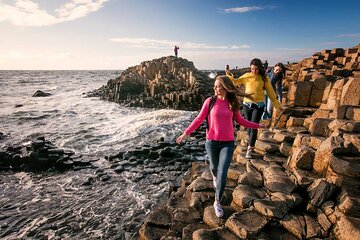
A mathematical maze of lava, picture the Giant’s Causeway like stepping stones into the ocean.
Resembling 40,000 patio tiles, the perfectly hexagonal basalt columns of Northern Ireland’s Giant’s Causewaylook entirely manmade. (Local legend says these were actually stepping stones laid down by Fion Mac Cumhaill, a giant crossing the sea to fight a Scottish rival.) However, the columns are in fact hardened lava that bubbled up from the Earth and cooled at a very specific temperature to create an interlacing geometric symphony.
Though similar formations exist throughout the world, none can match the grandeur of Giant’s Causeway ... but that means you often have to share this spectacular space with others—come early or near dusk to avoid the worst crowds.
Insider tip: Beautiful coastal walks line this area. To avoid the parking fee, walk from either Dunserverick Castle or Portballintrae. Of course, you can always book a a guided tour of this UNESCO World Heritage Site, too.
5. Tsingy de Bemaraha National Park, Madagascar

Don’t walk barefoot in this Madagascan spot.
With flora and fauna that can be found nowhere else, the island of Madagascar is one of the most biodiverse spots on the planet. One spot that embodies this blend of biodiversity is Tsingy de Bemaraha National Park. In Malagasy, Tsingy means “where one cannot walk barefoot”—and that’s no joke. Here, thousands of limestone spikes stand sentinel, making the ground unnavigable—even for lemurs.
However, to explore the park, humans can walk along aerial suspension bridges above the limestone to reach savannas and mangrove swamps. Book a tour out of the coastal town of Morondava and stay in one of the lodges in Bekopaka.
6. Big Island of Hawaii, Hawaii, US

The Earth’s tallest mountain, on the Big Island of Hawaii, offers big-time adventure.
One of the best things to do on the Big Island of Hawaii is see Hawaii's Mauna Kea for yourself. Rising 13,796 feet (4,205 meters) above sea level and extending about 19,700 feet (6,000 meters) below sea level, Hawaii’s impressive mountain clocks in at 33,500 total feet (10,211 meters)—the tallest mountain on the planet.
Dormant Mauna Kea is not far from Kilauea, an active volcano that is the highlight of Hawaii Volcanoes National Park. Witness the glow from Kilauea Crater, trek down the steaming hiking trails, or take a scenic ride down Chain of Craters Road. Meanwhile, located at 9,200 feet (2,800 meters), Mauna Kea’s visitor center makes for some absolutely spectacular stargazing.
Related: Know Before You Go: Visiting Mauna Kea Summit and Observatory
7. Yellowstone National Park, Wyoming, Montana, and Idaho, US

A geothermal wonderland, Yellowstone National Park bubbles like a volcanic bathtub.
Home to more than half of the world's geysers, Yellowstone National Park sits atop a massive supervolcano, with thousands of hydrothermal features at or beneath the surface. Old Faithful erupts roughly every 90 minutes, shooting water up to 180 feet (55 meters) high, while nearby Grand Prismatic Spring dazzles visitors with its rainbow-ringed pool.
Beyond the geysers, hop on a tour to witness wildlife thundering across Lamar Valley, or hike along the park's 2.2 million acres (89,000 hectares), which span three states and offer everything from backcountry wilderness to boardwalk strolls through steaming thermal basins.
8. Mt. Everest, Nepal

Test yourself on the ultimate high-altitude adventure: Mt. Everest.
Standing at 29,032 feet (8,849 meters) above sea level, Mt. Everest draws adventurers to Nepal for the trek of a lifetime. While summiting requires serious mountaineering experience, the classic Everest Base Camp trek offers breathtaking Himalayan views without technical climbing.
The journey through Sherpa villages, Buddhist monasteries, and rhododendron forests culminates at 17,598 feet (5,364 meters)—along the way, explore colorful markets, visit ancient monasteries, and witness sunrise over Earth's most legendary mountain.
Related: Know Before You Go: Trekking to Mt. Everest Base Camp
9. Grand Canyon National Park, Arizona, US

Witness 2 billion years of Earth's history all in one place at the Grand Canyon.
Carved by the Colorado River, the Grand Canyon stretches for 277 miles (446 kilometers), reaching up to 18 miles (29 kilometers) wide and plunging over a mile deep into ancient rock. The South Rim offers year-round access, featuring spectacular viewpoints including Hopi Point for sunset and Mather Point for sunrise.
However, adventure seekers can also raft the Colorado River through the canyon's heart, hike the challenging Bright Angel Trail to the river, or take a helicopter tour for a sky-high perspective. Regardless of how you choose to explore, you'll be in awe here, a place whee every layer of rock tells a story.
10. Cappadocia, Turkey

Sleep in, stroll through, and float above Turkey's fairy-tale landscape.
Millions of years of volcanic action sculpted Cappadocia's surreal "fairy chimneys,” towering rock formations that early Christians in Turkey carved into churches, homes, and entire underground cities. Today, you can explore ancient cave churches with Byzantine frescoes, venture into the 8-level underground city of Derinkuyu, or wander through the dramatic valleys of Pasabag and Devrent.
But the crown-jewel experience here is definitely a hot-air balloon ride—ideally one that lets you float over the otherworldly rock formations at sunrise—before sleeping in a luxury cave hotel for the full dawn-to-dusk adventure.
11. Victoria Falls, Zambia and Zimbabwe

Watch Victoria Falls, one of the world’s grandest waterfalls, put on its cascading show.
The Zambezi River plunges 354 feet (108 meters) into a narrow gorge, creating one of the world's most spectacular waterfalls: Victoria Falls. The cascade is so thunderous, it generates mist visible from 30 miles (50 kilometers) away. Peak flow during April and May creates an overwhelming wall of water, while lower water levels from September to December reveal the falls' geology and allow for the famous Devil's Pool swim on the Zambian side.
If that's not enough for you though, adventure activities abound here, whether you want to bungee jump from Victoria Falls Bridge, whitewater raft the Zambezi's rapids, or take a helicopter flight over the falls.
Book more things to do in Asia




Keep planning your Asia trip


