
Know Before You Go: Visiting the Salar de Uyuni


Boasting the accolade of the world’s largest salt flat, the Salar de Uyuni is not only Bolivia’s top attraction—but one of South America’s, too. Sitting pretty at the bottom of the Andes mountains range, the brilliant white flats are famous for their spellbinding mirror effect and for the way they distort your perception of distance (you’ll be hard-pushed not to find a social media snap of the natural wonder that doesn’t show people pretending to run from dinosaurs or eat one another on a spoon.) They’re so big and bright that you can see them from space. But the prospect of tackling these sprawling, honeycomb lands alone can feel a little overwhelming—so, here’s how to enhance your experience of the literal salt of the earth.
What is the Salar de Uyuni?

It's the world’s largest salt flat, located in Bolivia.
Said to have been formed when a prehistoric lake ran dry, the Salar de Uyuni is a sprawling white landscape estimated to harbor 10 billion tons of salt. It forms hexagonal shapes reminiscent of a honeycomb when dry and creates a dazzling mirror effect when wet. You’ll find the world’s largest salt flat in southwest Bolivia, near the Bolivia-Chile border, close to fellow world record holder, the Atacama Desert, which holds the title of the driest place on earth.
When’s the best time to visit Salar de Uyuni?

The wet and dry seasons create entirely different effects on the salt, so it depends on what you hope to see.
The best time to visit the Salar de Uyuni depends on what you want to see—but this natural wonder looks epic whenever you go. During the wet season, which stretches from December through March, morning rain transforms the salt flats into the world’s largest natural mirror. However, while creating incredible images, the heavy rainfall can sometimes make parts of the flat inaccessible. So, if you want to guarantee the best weather for exploration, visit September through December, when the weather is driest, and the sun creates photo-worthy honeycomb shapes on the surface.
How can I get the best photos of the Salar de Uyuni?

Play around with props and perspective, and have your guide lend a land.
Speaking of photos, you've likely seen pictures of the Salar de Uyuni on Instagram, as visitors love to make the most of the flat, white expanse to engage in some fun camera trickery. But how do you get the best photos of the Salar de Uyuni? The devil is in the detail.
First, pick your season carefully because, as mentioned, rainy season lends itself to those mirror-like reflection pics, whereas dry season is all about the honeycombed salt patterns. Secondly, get low to the ground and use angles and perspective to your advantage. Working in props is never a bad idea either. (That applies whether you want to make your far-away-from-the-camera friends look like they're sipping from a giant water bottle or being chased by a plastic dinosaur.)
Insider tip: When all else fails, have your guide step in. They're old hands at getting the best photos of the Salar de Uyuni, whatever the season.
How long should I spend in the Salar de Uyuni?

A day is long enough to see the flats, but 2–3 days means you can dive deeper.
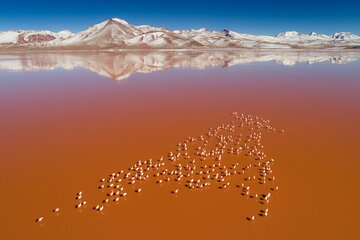
If your Bolivia itinerary is shorter than you’d like, it’s easy to explore the Salar de Uyuni in just one day—you can even take the plane from La Paz in the morning and spend the afternoon exploring the flats and watching the sunset later on. While one day is plenty to see just the flats and the Train Cemetery (Cementerio de Trenes), spending 2–3 days in Uyuni lets you take day trips to the surrounding Altiplano Desert, which is home to geysers, hot-pink lagoons, salt pools, and wildlife ranging from flamingoes to vicuñas. The town of Uyuni is small and well-equipped, yet not somewhere you need more than an hour or two to explore.
Should I take a tour to the Salar de Uyuni?

Yes, day trips help you skip the hassle of organizing transport and admission.
There are many moving parts to a Salar de Uyuni visit—and while you can visit the natural wonder independently, a day trip is the best way to experience it. Excursions typically take you to the salt flat for sunrise to see the surface create its world-famous mirror effect before the sun dries the salt. They also help you create perfect perspective-bending photos, often including visiting the Train Cemetery (Cementerio de Trenes), a weird collection of rust-covered, abandoned trains. Plus, 4WD vehicles are the most popular method for accessing this rugged terrain.
Insider tip: All-terrain vehicles aren't the only way to explore the flat, though—cycling tours have seen a sharp rise in popularity and offer a truly unique route for cyclists. It's easy to lose your way on this seemingly endless stretch of white, though, so opt for a tour to ensure you’re not stranded among the salt come sunset.



How can I get to the Salar de Uyuni?

You can take a bus from the capital or join a multi-day tour.
The small town of Uyuni is the gateway to the Salar de Uyuni and is typically the jumping-off point for all tours. Depending on your time, budget, and where you’re coming from, you can take an 8-hour bus ride from the capital of La Paz (overnight bed buses ensure you get at least some rest), a 4-day tour from the Atacama Desert from Chile, or a multi-day tour from Arequipa in southern Peru. You can also fly from La Paz to Uyuni—flights typically only depart once a day and only take one hour, which is ideal if you want to make the most of every minute.
Insider tip: At a whopping 12,000 feet (3,657 meters) above sea level, the elevation of the Salar de Uyuni can cause altitude sickness—symptoms include nausea, headaches, and dizziness. If you’ve flown directly to Bolivia from lower altitude countries, it’s a good idea to spend a few days relaxing and acclimatizing before doing anything too strenuous.
How far is Salar de Uyuni from La Paz?

The salt flats are easy to reach from Bolivia’s bustling capital, around 8 hours by car or a quick flight.
The Salar de Uyuni is 240 miles (410 kilometers) from La Paz—it takes around eight hours between each by car. If you’re taking a daytime bus, budget a couple of hours extra to take the traffic into account. It takes around one hour to reach by plane, and you can book a flight with BOA airline—flights typically depart early in the morning and book up quickly during the high season, so it’s well worth booking in advance or opting for a Salar de Uyuni tour that takes care of everything for you.
Insider tip: Although you might be tempted to take a night bus to save time, taking a day bus lets you soak up the scenery between the city and the salt. Bolivia’s landlocked landscapes encompass deserts, mountains, lakes, and lush greenery, so sleeping through this journey would be a shame.
Can I stay overnight on the Salar de Uyuni?

Yes, you can even stay at a hotel made entirely of salt.
There are many accommodation options in Uyuni, the town beside the Salar de Uyuni. While hostels and basic accommodation are more prevalent, you can find several luxury options. One of the most famous is the Palacio de Sal Salt Hotel, built from more than 1 million blocks of salt, which need to be sculpted daily to help them retain their shape. Hotel Luna Salada offers panoramic views of the salt flats and is made entirely of salt.
What should I wear to the Salar de Uyuni?

Dress for the extremes of desert weather.
The salt flats are at their coldest between May and September when daytime temperatures aren’t much more than freezing and nighttime climes plummet down to (26°F) -3°C—be sure to wrap up warm and take plenty of layers. Daytime temperatures reach highs of 68°F (20°C), so you’ll want to wear lighter clothing for a day on the flats. But as you can imagine, there’s not much shade on the world’s biggest salt flats, so wear plenty of sunscreen and a cap and sunglasses to protect your eyes from the intense glare.
Is the Salar de Uyuni wheelchair accessible?

Not entirely, but some tours may make it possible to visit as a wheelchair user.
The Salar de Uyuni is a natural landscape, so you won't really find many paths and pavements to ease access. That also means you're likely to come across uneven ground, slippery surfaces, and even puddles in the wet season that may make the flats quite difficult, if not impossible, to navigate as a wheelchair user or someone with mobility issues. However, some tours may offer wheelchair accessible experiences, meaning you don't have to skip over on one of South America's most popular sights.
Frequently asked questions

Everything you need to know about the Salar de Uyuni.
- Is Salar de Uyuni safe? The Salar de Uyuni itself is a very safe place to be—the only thing you might consider dangerous is driving. The town of Uyuni that borders the salt flats is also safe, as long as you take the usual precautions of keeping a close eye on your belongings and avoid going out alone late at night.
- Which cities and towns are closest to the Salar de Uyuni? The town closest to the Salar de Uyuni is Uyuni, a small yet well-equipped town with plenty of overnight accommodation options. Another popular gateway to the flats is San Pedro de Atacama, across the desert in Chile, from which many tours depart.
- How big is the Salar de Uyuni? The Salar de Uyuni stretches for more than 4,000 square miles (10,360 square kilometers), making it the largest salt flat in the world. The enormous salt desert draws hundreds of thousands of visitors annually and was even used as the setting for Star Wars VIII: The Last Jedi.
- How is the sky reflected at the Salar de Uyuni? The mirror effect on the Salar de Uyuni only happens during the rainy season from December to April. It occurs when the nearby lakes overflow and spill onto the flats to create an incredible optical illusion. While the flats only receive up to 5 inches (12 centimeters) of rain, it has a magnificent impact on how they look.
Book more things to do in Bolivia


Keep planning your Bolivia trip


