
Know Before You Go: Going Whale Watching in Hawaii


Hawaii, from the Big Island to Kauai, offers some of the best places to go whale watching in the entire world. From December to May—Hawaii’s prime whale-watching season—you can spot whales breaching, tail slapping, and spouting throughout the island chain.
While it’s possible to catch a far-off glimpse of the action from shore, the best experiences are to be found on dedicated Hawaii whale-watching tours that get you much closer to to the action to observe these majestic marine mammals (while keeping a safe distance). Here’s what to know about whale watching on the Big Island and beyond.
Which Hawaiian Island is best for whale watching?

Conditions for whale-watching in Maui might be a bit better than the rest.
Sitting pretty between the islands of Maui and Lanai, the Auau channel is known as a hot spot for whales: so it's ideal for Maui whale watching. It’s a smidge warmer and shallower than the surrounding waters—just what migrating whales are looking for! As a matter of fact, this channel has been part of the Hawaiian Islands Humpback Whale National Marine Sanctuary since 1992.
That said, whales can be found off the coast of just about every Hawaiian Island during whale season. Oahu’s southeastern coast and the Big Island’s Kohala Coast are both noteworthy whale-watching locations as well.
When’s the best time for whale watching in Hawaii?

The best time of year for whale watching is in the winter, while the best time of day is in the morning.
Whale watching in Hawaii runs from December to May, with January through March being peak season. This is, without a doubt, the best time to book your whale-watching tour. Some companies offer whale-watching tours year-round, but the likelihood of seeing whales outside of this seasonal window is much slimmer. However, other types of Hawaii marine life tours may be available when whales aren’t migrating.
As for the time of day, aim for a morning cruise if possible. The whales are out and about really whenever they please, but the waters are a bit calmer before 10am.
What kinds of whales will I see while whale watching in Hawaii?

You’ll primarily see humpback whales in Hawaii, although other species might make an appearance too.
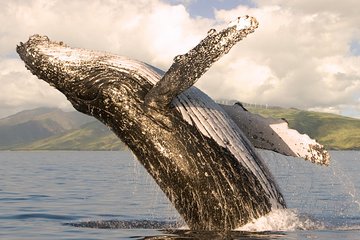
Humpbacks are the highlight of any whale-watching excursion in Hawaii. They’re the whales that migrate here during the winter with all of their eye-catching acrobatics—breaching, tail slapping ... you name it. Other whale species, such as sperm whales, do also make their home in Hawaii, but they’re rarely spotted. Instead, you might see various species of dolphins—many of which are mistaken for whales—such as short-finned pilot whales, false killer whales, and spinner dolphins.
What tour options are available for whale watching in Hawaii?

There are dozens of tour companies that offer Hawaii whale-watching cruises for any preference.
No matter your preference, there’s likely to be a whale-watching tour in Hawaii to suit your needs. Cruises depart from most islands at nearly every time of day. There are large- and small-group tours, and even private cruises and sailing trips, from budget to luxury options.
While most Hawaii whale-watching cruises take place by catamaran or sturdy rafting vessel, you’ll even find a few kayak excursions.




Can I swim with whales in Hawaii?

No, you cannot swim with whales in Hawaii.
For your safety and the safety of the whales, Hawaii law states that you cannot swim or pursue whales within 300 feet (100 yards). If the whale approaches you, you must remain stationary; you cannot approach the whale. (The same laws apply to boats, which is why most tour companies will head out to a consistent whale-spotting location, then cut the engine and wait for the marine mammals to swim closer.)
What should I bring to whale watch in Hawaii?

You only need the basics to go on a Hawaii whale-watching excursion.
A few hours of whale watching also means a few hours out in the Hawaii sunshine. Protect your skin (and eyes) appropriately with reef-safe sunscreen, a hat, and a pair of sunglasses.
One additional whale-watching tip for Hawaii: You may want to consider wearing flip-flops or other easy-to-slip-off shoes, as some boating companies will ask that you remove your shoes upon boarding. This is both to preserve the boat itself and to reduce your risk of slipping and falling in shoes with no or low traction.
Is whale watching in Hawaii accessible for people with disabilities?

Hawaii whale watching accessibility depends on the tour company.
While the goal would be for every boat and every tour company to be accessible to all, that’s unfortunately not the case. Your best bet is to look for whale-watching cruises that use stable catamarans (as opposed to those that use smaller rafts, for example). It’s recommended to call the company to ask about the boarding ramps, restroom entryways, and deck maneuverability to see if their vessels work for any specific mobility needs.
Frequently asked questions

Everything you need to know about going whale watching in Hawaii.
How long are whale-watching tours in Hawaii? Tours are typically between 90 minutes and three hours.
Where do Hawaii’s whales migrate from? They swim down from the Northern Pacific, off the coast of Alaska and British Columbia, Canada.
Why do the whales migrate? Humpback whales are the migratory whales found in Hawaii. When they spend summers in the colder regions, they eat to their hearts’ content. And when they swim down to Hawaii, they essentially fast and use the time in the warm waters to breed.
Are whale sightings guaranteed? It depends on the tour company. If your chosen tour guarantees whale sightings and you don’t see any, you will be welcomed back for another tour. For that reason, it’s best to book your whale-watching tour earlier in your trip.
What if it rains? Most whale-watching tours will continue as planned in light rain.
Will I get seasick? If you are prone to seasickness, you will likely get seasick on a whale-watching tour. Consider taking the appropriate medication beforehand.
Can you see whales from the shore? Sort of. If you know what to look for, you can see whale spouts in the distance. You likely won’t actually see any part of the whale though, at least not with the naked eye, unless you use binoculars.
More ways to explore Hawaii




Keep reading


