
9 of the Top Gaudí Buildings in Barcelona and How To Visit


One of the leaders of the Modernisme movement—the Catalan take on art nouveau—Antoni Gaudí’s unique design style shaped Barcelona at the turn of the century. His love of natural forms, dedication to color, and rejection of straight lines influenced a whole generation of artists and architects. He may be known worldwide for the unfinished Sagrada Familia, but there are many more Gaudí landmarks across Barcelona waiting to be explored. If you’re looking for the best Gaudí buildings to visit, you’re in the right place. Here’s our guide to Gaudí buildings in Barcelona, and how to see them.
1. Park Güell

The architect’s landscaped park is a must-visit on any Barcelona Gaudí tour.
Originally designed by Gaudí as a high-end housing development for his biggest patron, Catalan entrepreneur Eusebi Güell, the project was a commercial failure. Güell’s loss was the city’s gain, though, and Park Güell became a public space in 1922. Highlights here include the gingerbread house entrance, the mosaic serpentine bench, and the cave-like porticos—not to mention sweeping views from the top of the park. The Gaudí House Museum (Casa Museu Gaudí), where the architect once lived, is also worth visiting.
Insider tip: Booking ahead is essential and means you can skip the long lines, while a guided tour may ensure you don’t miss the best bits.
2. La Sagrada Familia

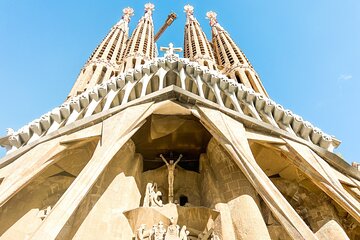
The most famous Gaudí building, the majestic Sagrada Familia is a church like no other.
Most famous for never being finished, La Sagrada Familia is set to finally be completed in 2026, exactly 100 years after Gaudí’s death. Work started on the giant church in 1882 with architect Francisco de Paula del Villar, but Gaudí soon took over.
Finished or not, this is one spot that's truly spectacular inside and out—from the kaleidoscopic windows and tree-like columns to the grand honeycomb towers and intricate frescos. You need to purchase tickets to go inside, and these often sell out, so get skip-the-line tickets in advance or book a guided tour to learn more about this spectacular building.
3. Güell Palace (Palau Güell)

A top Gaudí building, Güell Palace is a prime example of early Gaudí architecture in Barcelona.
Built for Güell as his family residence, this neo-gothic mansion is located in the neighborhood of El Raval, just off the famous La Rambla. From the outside, Güell Palace appears rather austere with its gray and white stonework, but make sure you head inside to see the luxurious interiors. Spread across seven floors, Palau Güell has horse stables in the basement, a glamorous hall for entertaining, and a trademark Gaudí rooftop with chimney pots covered in colorful tiles. You need tickets to go inside or you can book a private tour of Gaudí attractions in Barcelona to learn more.
4. La Pedrera (Casa Milà)

La Pedrera offers a showcase of Gaudí’s signature style at its most elegant.
Originally known as Casa Milà thanks to the businessman who commissioned it, today it goes by the name La Pedrera (the Quarry) due to its gray stone facade. Declared a UNESCO World Heritage Site in 1984 and opened to the public in 1996, this was Gaudí’s last work before he dedicated himself entirely to La Sagrada Familia.
Here, you can witness elaborate metalwork, mosaic-tiling, and beautiful courtyards alongside a rooftop with 360-degree views of the city. Don’t miss the 4th-floor apartment that shows how a bourgeois family lived in the early 20th century. You must book in advance; it's best to get skip-the-line tickets to visit one of Gaudí’s most popular buildings in Barcelona.
5. Casa Batlló

Casa Batlló is a Modernisme masterpiece—and a trippy tribute to nature.
Located on what is now Barcelona’s biggest shopping street, Passeig de Gracia, Casa Batlló is hard to miss. The front is covered head to toe in iridescent broken tiles and studded with jaw-like balconies that give it its nickname, Casa del Ossos (House of Bones). Once inside, you’ll be treated to an equally fantastical setup with swirling shapes at every turn, from the staircase to the windows and the ceiling.
Don’t skip the rooftop either, with its impressive terrace inspired by a dragon—a supposed reference to the legend of Sant Jordi (St. George), the patron saint of Catalonia. Much like La Pedrera, you’re best off booking in advance and getting skip the line tickets. Or, if you’re short on time, book a tour to see all of Gaudí’s top sites in one day.
6. Casa Vicens

Gaudí’s first residential project, Casa Vicens, is a hidden architectural gem.
Built between 1883 and 1885, Casa Vicens was Gaudí’s first major work to be finished. Slightly more understated than his later mansions on Passeig de Gracia (Casa Batlló and Casa Milà), it still offers a stunning array of colors thanks to ceramic tiling and glass windows, as well as intricate woodwork and carving. Opened to the public in 2017 after a major restoration, it’s a peaceful spot to spend some time, and is home to a lovely rooftop and a shady garden. To guarantee you can skip the line, book your tickets in advance.
7. Colonia Güell

Head to Colonia Güell for your chance to see an entire town designed by Gaudí.
Fourteen miles (23 kilometers) outside of the city, Colonia Güell was designed as a worker’s colony for Güell’s textile factory. The plan was for a fully self-contained town complete with shops, restaurants, schools, and even a theater. Although the project was never finished, it’s a fascinating spot to explore and see many of Gaudí’s signature architectural details. Don’t skip the crypt, the only complete building that showcases many techniques Gaudí went on to use for the Sagrada Familia. Take the train or make life easy and book a guided tour with a private transfer included.
8. Torre Bellesguard (Casa Figueres)

Torre Bellesguard was inspired by a medieval castle that once stood on the same site.
Found in the neighborhood of Sarrià-Sant Gervasi, a wealthy residential district that the majority of tourists don’t visit, Torre Bellesguard is one of the least crowded of Gaudí’s buildings. One of his only edifices that uses straight lines, this modernist meets neo-Gothic manor house is most recognized for the tower that gives it its name, Bellesguard (“beautiful view” in Catalan). The interior is quintessentially Gaudí with colored glass, tall arches, and a dragon-inspired terrace. So, if it’s lesser-known Gaudí buildings you’re interested in, consider booking a tour that includes Torre Bellesguard.
9. Casa Calvet

See Casa Calvet, one of Gaudí’s earliest works on a stroll through the city center.
Built for textile manufacturer Pere Màrtir Calvet in 1899 as his business premises and private residence, Casa Calvet was crafted from stone quarried on nearby Montjuïc (the hillside park that hugs the south of the city) and features impressive wrought ironwork balconies. It’s not open for visits, but you can glimpse the impressive facade on a Barcelona bike tour. Plus, it’s centrally located right behind Plaça de Catalunya, so you can even stroll past independently while exploring the city.
Book more things to do in Barcelona




Keep planning your Barcelona trip


