
I Discovered the Best Way To Visit the Louvre on This Guided Tour


The first thought I had upon arriving at the Louvre was “uh-oh.” As my husband and I strolled into the museum’s main courtyard, we were met by a crowd scene straight out of Bruegel—or maybe Bosch. It was an overcast holiday Saturday, and we clearly weren’t the only ones who’d thought an afternoon in the storied Paris art museum would be a good way to spend the time.
Viewing the masses congregated outside, I suddenly doubted our decision (and remembered a pertinent statistic: The Louvre is the most-popular museum on Earth, with a whopping 8.7 million visitors per year). In front of its pyramid entrance, hundreds of people waited in snaking lines to get in. And although we’d prebooked a small-group collection highlights tour, I had a sinking feeling that it would take us hours just to get in the door.
However, just when I was losing hope, I spotted a small blue flag flying above the crowds: the sign our tour guide Martin had told us to look out for. We found him holding it aloft, and were soon joined by our four fellow tour attendees. Once we were gathered, he launched into a brief introduction to the museum’s architecture. Then, without further ado, he pulled our prebooked tickets out of his pocket and led us straight to a special tour group entrance, far from the endless queues. In a matter of moments, we were in. That internal “uh-oh” turned into a deep sigh of relief.

Once inside, we stopped for a moment to admire the pyramid from below before Martin surprised us again—this time by guiding us to the dedicated group welcome area. There, we had time to catch our breath and stop for a quick bathroom break, all without waiting in any lines. Just five minutes in, and we were already reaping the rewards of visiting on a tour rather than on our own.
Suitably refreshed, we kicked things off with a bit of museum history that unguided visits wouldn’t include. “The Louvre used to be a royal palace,” Martin told us. And here we were, on the basement level, walking right next to its former ramparts and under its medieval bridges. It took looking at a model of the museum, and squinting our eyes, to imagine the building as it was centuries ago—the River Seine once flowing right where we stood.
But it was finally time to delve into the museum’s collection. Home to an extraordinary 500,000 objects spanning 10,000 years of history—of which some 35,000 are on display at one time—the museum is almost unfathomably vast. So vast, we joked with Martin, that we could repeat the tour every day for a year and still not see it all. “Don’t worry—I’ll make sure you see the best,” he grinned, before leading us to the Crypt of the Sphinx.

Though the Louvre contains more than 6,000 ancient Egyptian marvels alone, the Great Sphinx of Tanis is a clear highlight. One of the largest sphinxes outside of Egypt, it was carved from rose granite and dates as far back as 2,620 BC. Alone in its stone arch, it exuded an almost lifelike presence.
From there, we followed Martin on a convenient route through a series of interconnected galleries, which covered a wide variety of the Louvre’s masterpieces. Leaving Egypt behind, we continued to ancient Greece and Rome, the galleries almost overflowing with priceless treasures: exquisite caryatids, sculptures by Praxiteles, and a statue of Sleeping Hermaphroditus that featured a Renaissance–era mattress carved by Bernini. “It looks so real, I think it will be soft if I reach out and touch it,” Martin laughed.
As we explored, the pace was just right—quick enough to maximize our time, but not so fast that we felt rushed, even as we made our way past big tour groups. We even had plenty of time to soak in the beauty of one of the Louvre’s best-known pieces: the Venus de Milo. As we admired it, Martin explained that the sculpture represented a radical step forward in the history of representational art.

Next, we rounded a corner and continued up a staircase to another Louvre must-do: the Winged Victory, or Nike of Samothrace. The position of the statue at the top of the stairs was intentional, and invited us to ascend as worshippers, Martin explained; he also pointed out that she stood on a base resembling the prow of a ship. We had to imagine her landing on the vessel in stormy seas, the wind ruffling her feathered wings and blowing her garments, he said. I could almost feel the cold sea spray as I looked on, transfixed.
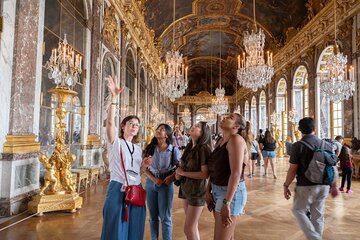
After spending 10 minutes taking in the sculpture from all angles, we detoured to a different wing of the museum: the sumptuous Galerie d’Apollon. Its fantastically ornate design was a model for the Palace of Versailles’ Hall of Mirrors, as Martin explained. Fittingly, the room happens to contain the French Crown Jewels. We gasped at the 140.6-carat Regent Diamond, a diamond brooch belonging to Empress Eugénie, and pearl earrings once worn by Joséphine Bonaparte.
We left the gallery suitably dazzled—but the best was yet to come, as we headed towards the Louvre’s landmark Italian Renaissance collection. We began with several of Leonardo da Vinici’s lesser-known works, including Saint John the Baptist and The Virgin of the Rocks. Then, it was time for the top tour highlight: the iconic Mona Lisa.

As the Louvre’s most popular artwork, the Mona Lisa was expectedly thronged with photographers and selfie-takers, while its size—smaller than you’d expect—made it hard to see from farther away. But as Martin saw me struggling to get through the crowds, he pulled me to one side and quietly pointed out the fastest-moving part of the queue—definitely a plus of visiting with an expert. Soon, I was face to face with the world-famous “Mona Lisa” herself, with plenty of time to ponder the source of her enigmatic smile.
Seeing the Mona Lisa in person was certainly a thrill—although it wasn’t the end of our comprehensive Louvre highlights tour. Next, we continued to the museum’s collection of 19th-century paintings, which I was just as excited to see. We marveled at the composition of Géricault’s Raft of the Medusa (and learned the gruesome story behind its subject matter), and felt the revolutionary spirit of Delacroix’s “Liberty Leading the People.”
By this point, several teenage members of our group were approaching their limit for art appreciation, so they said goodbye—and the two of us spent the remaining 20 minutes of the tour with Martin as our private guide.

We weren’t sure what to expect, as we followed him through galleries, down a staircase, and to a beautifully quiet part of the museum that most visitors skipped over. Martin’s enthusiasm and knowledge were apparent as he took us to the Palace of Sargon II—the remnants of an Assyrian city dating back to the 8th century BC—and to see the ancient Etruscan Sarcophagus of the Spouses.
By then, it was almost time for us to go—and we felt content knowing that we’d seen the best of the museum, plus some lesser-known pieces, too. “But first, do you want to see the oldest artwork in the museum?” Martin asked, knowing full well that this kind of insider insight would pique our interest. “Of course,” we said—and so we found ourselves in front of the Statue of Aïn Ghazal, discovered in what is now Jordan and dating to the Neolithic period. Compared to all the ornate works we’d seen earlier, it looked simple, even rustic—it was certainly something we wouldn’t have dedicated time to on our own. But there was something vivid and captivating in the figure’s gaze and curious pose.

“Sometimes, I want to cry when I see it,” Martin confessed. Tears prickled in my own eyes as I looked at it. It was unexpectedly moving to think of this plaster being patted into shape more than 7,000 years ago. How extraordinary it was, I thought, that this art-making impulse had been with us humans for so many millennia. And how miraculous it felt to come face to face with this ancient work, across continents and time.
“I understand,” I told him. “I want to, too.”

This tour was provided courtesy of Viator.
More ways to explore Paris





Keep reading


