
8 St. Patrick’s Day Traditions That Are Actually Irish


Sure, the Irish give good craic (aka good times), but St. Patrick’s Day celebrations in the homeland go beyond the rowdy parades and all-green everything that the patron saint’s feast day is associated with elsewhere in the world. From home-cooked meals to St. Patrick pilgrimages, here are some of the less-boozy ways the Irish celebrate St. Paddy’s Day in Ireland and Northern Ireland.
1. Eating an Irish roast dinner

A hearty, home-cooked meal is the star of many St. Patrick's Day celebrations.
Family and food is at the heart of St. Patrick’s Day festivities in Ireland and Northern Ireland. Like Thanksgiving in the US, St. Paddy’s is all about getting together with family and friends, and eating far too much food. The roast dinner is the main event: beef or lamb served with roast potatoes or colcannon (potatoes mashed with cabbage and leeks), vegetables, and gravy are all customary. Fish pie, shepherd's pie (minced lamb topped with mashed potatoes), and soda bread (with a cross cut in the center to keep the fairies out) are also popular staples. Corned beef and cabbage, you might be surprised to hear, are not.
2. Wearing a (real) shamrock

Shamrocks are an Irish St. Patrick's Day symbol—as long as they're the real thing.
Shamrocks are as synonymous with pop culture perceptions of Ireland—and St. Patrick’s Day—as leprechauns, Guinness, and the color green. Irish legend says that St. Patrick used the shamrock as a metaphor to explain the Holy Trinity when converting the Irish to Christianity in the 4th century.
We’ve all seen the novelty shamrock glasses worn by the masses around the world on March 17, but in Ireland and Northern Ireland you’ll find folks wearing bunches of real shamrocks. These little bunches are worn pinned over the heart and blessed by the priest or bishop during St. Patrick’s Day services.
3. Attending Mass or a church service

Until the late twentieth century, St. Patrick's Day was a strictly religious (and alcohol-free) celebration.
St. Patrick’s Day, which marks the death of the patron saint, is historically a religious holiday. (Side note: It’s only in recent decades that Ireland’s St. Patrick’s Day celebrations extended beyond those of the religious kind.)
This means that it's a Holy Day of Obligation for Catholics and a feast day for the Anglican Communion, including the Church of Ireland, which means practicing Catholics and Christians often attend religious services—typically with those aforementioned shamrocks pinned to their shirts for the traditional Blessing of the Shamrock.
Did you know?: Pubs in Ireland couldn’t open on St. Patrick’s Day until the ‘70s, and it wasn’t until the ‘90s that the Irish government began marketing St. Patrick’s Day to encourage tourism.
4. Drinking a real Irish pint

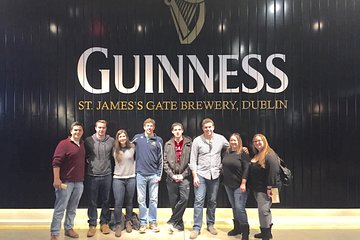
Celebrate the holiday with a stout pint of Guinness—or a trip to the storehouse.
Forget green beer, the Irish like their tipples a little darker. Guinness is the beer of choice on St. Patrick’s Day—and on most days—in Ireland and Northern Ireland. This dark ruby stout, the world’s best selling Irish beer, has been brewed at St. James’s Gate in Dublin since 1759.
The Guinness Storehouse, which is on the site of the brewery’s old fermentation plant, showcases the best of Irish culture and craic throughout Dublin’s St. Patrick’s Festival, with a céilí mór (a big dance and celebration of all things Irish folk culture) featuring a live band, traditional dancers, real Irish food, and complimentary pints of the black stuff.
5. Listening (or dancing) to Irish folk music

St. Patrick's Day in Ireland and Northern Ireland is one of the best times to hear traditional music.
The sound of fiddles and bodhrán drums can be heard floating out into the streets from pubs throughout the year, but the Emerald Isle comes alive with traditional folk music for St. Patrick’s Day. Pubs all over both countries play host to Irish folk bands, and in the big city’s buskers take to the streets.
In Dublin, O’Donoghues, O’Neills, Gogarty’s, and The Cobblestone are among the best Irish pubs to catch a live session, while in Belfast, Fibber Magee's, the John Hewitt, Kelly's Cellars, and the Duke of York top the list.
6. Watching a St. Patrick’s Day parade

Cities across Ireland and Northern Ireland host St. Patrick's Day parades.
Dublin puts on the biggest St. Patrick’s Day parade, with about half a million people attending the last event, but there are hundreds of parades across Ireland and Northern Ireland. In Belfast, the revelry resembles Dublin—a green-clad international crowd and drunken shenanigans.
Locals not looking for a big party might skip the city parades and head to more low-key celebrations in nearby towns and villages. Downpatrick, where St. Patrick is said to be buried, and Armagh, where it’s believed St. Patrick built his first stone church, are two Northern Ireland towns where festivities are closely tied to the patron saint.
Did you know?: Ireland’s first St. Patrick’s Day parade wasn’t held until 1903, 302 years after the world’s first recorded St. Patrick’s Day parade in what is now St. Augustine, Florida. But it’s said that the tradition of parading on St. Patrick’s Day didn’t really begin until 1762, when a group of Irish soldiers serving in the British army marched through the streets of New York.
7. Visiting real-life St. Patrick sites

Visit the sites of St. Patrick's life.
Northern Ireland is St. Patrick’s homeland. Downpatrick is where pilgrims can visit his grave, see where his first church stood, and learn about his life at the St. Patrick’s Centre. Over in Armagh, there are two cathedrals named for him as well as the trailhead for the 82-mile (132-kilometer) St. Patrick’s Way.
For those in or around Dublin, the most accessible St. Patrick attraction is an island off the coast of nearby Skerries. Legend has it that St. Patrick spent time resting on the isle that’s now named after him. Here, you can come to see the ruins of an early Christian monastery and search for the rock marked with the saint's alleged footprint.
8. Watching live sporting events

Dublin hosts the Gaelic football finals each St. Patrick's Day.
Traditionally, the All-Ireland Senior Club championship finals for hurling and Gaelic football are hosted at Croke Park in Dublin on St. Patrick's Day. Sports fans come from all over the country to watch the games live, while many more tune in from home. The final for the Six Nations Championship, which sees the England, France, Ireland, Italy, Scotland, and Wales rugby union teams compete against each other, also typically falls around March 17, which adds to the festive atmosphere.
Book more things to do in Ireland






Keep planning your Ireland trip


