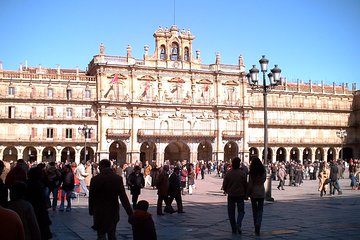
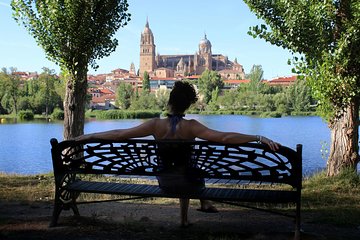
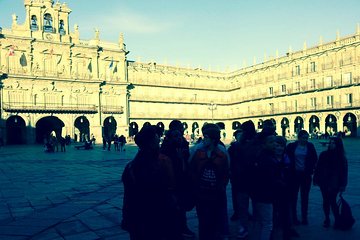
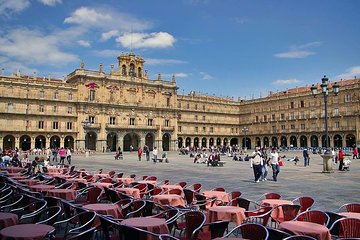

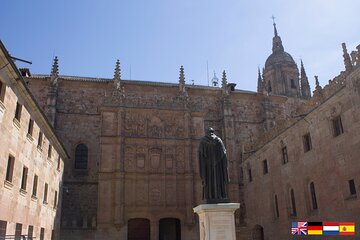
Cityscape view with Salamanca Cathedral in the middle, Salamanca city, Spain

Things to do in  Salamanca

City with the golden touch

Nicknamed Spain’s “Golden City” thanks to its extensive sandstone architecture, Salamanca is a major cultural destination in Spain’s interior. Its university is the oldest in Spain, providing a youthful atmosphere that contrasts nicely with its historical center, where you'll find many things to do. Extravagant churches, houses, and squares make the city a feast for the eyes, while its fondness for Iberian ham (jamón Ibérico) and other cured meats make it a feast for the tastebuds, too.

Top 1 attractions in Salamanca

Explore Salamanca by interest

Top activities in Salamanca

All about Salamanca

Local Currency
Euro (€)
When to visit

Between May and October is the best time to visit Salamanca, as that’s when the weather in the city is at its best. The city is much less likely to be busy outside these months, but the temperature does get reasonably low over winter, so you’ll need to take that into account. Religious holidays such as Holy Week (Semana Santa) at Easter, Corpus Christi in July, and the Salamanca Fair in September dominate the city’s events calendar.

Getting around

Given the layout of Salamanca’s historical center, walking is going to be the most effective way to visit most of the city's main attractions. City buses operate in a ring around the historical center and connect to outer areas, such as the Salamanca train station and south of the Tormes river. Driving in the historical center is restricted in many parts to authorized vehicles and is full of one-way streets that are hard to navigate.

Traveler tips

While the city's buildings and architecture are impressive enough when sightseeing during the day, don’t miss out on Salamanca’s historical center at night. The buildings here, particularly those abutting the main square (Plaza Mayor), look even grander when illuminated. As for where to go for spectacular city views, walk across the Enrique Estevan Bridge to the far side of the river.

en
a760f518-5955-414f-b5e7-4b0c7cd5a079
attraction_list
People Also Ask
Q:Is it worth visiting Salamanca?
A:

Yes, Salamanca is a destination worth visiting for travelers, thanks to its UNESCO–listed old town full of elegant sandstone architecture. Not only is the historical center of Salamanca picturesque, but it’s also loaded with culture: The University of Salamanca, one of the oldest universities in the world, has been operating since its establishment in 1218.

Q:How many days in Salamanca is enough?
A:

Allow at least two days in Salamanca to thoroughly explore the city and its attractions at a comfortable pace. While one day in Salamanca is enough time to see the city’s main highlights, a short visit may leave travelers feeling a little rushed or like they’ve missed out.

Q:Is Salamanca a walkable city?
A:

Yes, Salamanca is a very walkable city (even though its historical center isn’t flat), as most streets in the city center are either pedestrian streets or have reduced traffic measures. Salamanca is also not a large city, meaning you can get to most places on foot unless you have limited mobility.

Q:What food is Salamanca known for?
A:

Salamanca is known for its cured meats, including salchichón (summer sausage), chorizo (spicy sausage), and jamón Ibérico (Iberian ham). Another food the city is known for is hornazo, a pastry filled with these cured meats and associated with Semana Santa, known in English as Holy Week.

Q:How should you spend a day in Salamanca?
A:

There are many ways to spend a day in Salamanca, but most are going to focus on the main attractions in the historical center. Begin at the Plaza Mayor to see its arcades, pop into Salamanca Central Market, admire city views at La Clerecía church, and walk down to the Roman Bridge.

Q:What are the top attractions to visit in Salamanca?
A:

Salamanca is home to a busy roster of historical and cultural attractions, with its most famous ones being the New Cathedral, the House of Shells (Casa de las Conchas), and the Art Nouveau and Art Deco Museum. Less well-known places include the Huerto de Calixto y Melibea garden and the Museum of Automotive History.