
Hiking to Èze with Nietzsche on the French Riviera


The sound of laughter-filled French erupted behind me. I turned to see a convertible MINI Cooper full of teenagers pointing at me as they zoomed around a bend. It was late in the morning, and I was standing at the entrance to the Nietzsche Path, near the train station at Èze-sur-Mer, France, which sits between Nice and the Italian border. It was June 2022, early in what would be coined the post-COVID summer.
I had heard that the path was a short 1.24-mile (2-kilometer) trail connecting the modern seaside town of Èze to the ancient walled village high above. But the kids’ response to my presence there gave me pause.
Maybe the hike was more strenuous than I realized? Or perhaps I just did not look like a serious trekker, given that I was wearing a sundress so short and tight that I had to spend a lot of time managing the hemline? My Vans also probably weren’t the correct footwear for the path—the trailhead sign recommended hiking boots. (The same sign also showed a squatting cartoon figure crossed out with a giant red X. I took this to mean there were no bathrooms, and that relieving oneself on the trail was strictly forbidden.) My small handbag held only a water bottle, a phone, and a bikini. But according to Google, the hike would only take an hour. I was undeterred.
The Nietzsche Path, known to locals as the Chemin de Nietzsche, is named, of course, for the great 19th-century German philosopher. The actual trail, however, is much older, originally constructed in the 12th century. Nietzsche made his home in Èze for a short time in the late 1800s, and he climbed this path frequently during his stay on the Côte d’Azur; the views provided inspiration for his later writings.

I had opted to walk to Èze instead of driving for more prosaic reasons: I was hoping to escape the crowded, highly developed towns along the shore road and enjoy a glimpse into what the French Riviera would have been like in past centuries.
The rise was immediate and steep. There were only twenty paces to the first switchback. Pausing under a tree, I turned to take in the view behind me. I could see the train station I had come from, but I was already looking down on it and the surrounding cluster of buildings. The other visible cities along the coast were miniature, and the waters of the Mediterranean were bespeckled with boats ranging from motor and sail boats to yachts and a cruise ship. Turning back to the path, I found myself surrounded by rocks, brush, and very little vegetation. In the densely populated hills of the French Riviera, I’d managed to climb into wilderness in just a few short minutes.
After two more turns, the view was gone, as was anything resembling shade. All signs of civilization had disappeared. Standing under the noonday sun, I felt like I was hiking through the desert. A desert with signs.

All along the path were signs quoting Nietzsche’s work, mostly stanzas of poetry and bits of philosophy. One poem, posted early in the climb, celebrated humanity and, presumably, the joy Nietzsche found in friendship: “Restless happiness in standing, gazing, waiting:— I wait for friends, ready day and night.” These lines, written over a century before the COVID-19 pandemic, struck me with a particular force. While Nietzsche had found happiness in waiting, I had struggled to find that happiness in the recent months of isolation, my own period of waiting for a return to family, friends, and life.
As the trail eased from the harsh back and forth of the early climb into a pattern of meandering curves, cutting a steep path through the unshaded rocks, I pondered my loneliness during the 2020 lockdowns. It wasn’t just that I had missed my existing social circles; what I also wanted was to meet someone new. I longed to escape my small, suffocating bubble for distant shores, to immerse myself in a new and different culture. The thing I missed most was travel outside my country’s borders.

As I walked, with Nietzsche’s words echoing through my head, I slowly became aware of the languages spoken by those I passed. French, German, and Italian; their sounds tickled my ears like bubbles of Champagne might tickle my nose. The hikers I passed wore all manner of footwear, including flip-flops and Crocs. But we had more in common than just a penchant for ignoring the trailhead signs: We were all travelers forgoing a bus or taxi to climb this ancient path. These fellow travelers, I thought, could be the friends for whom I’d been restlessly waiting.
More than halfway up the path, the trail widened again, offering fewer turns—but still no trees. Flights of ancient stairs offered a slight reprieve from picking my way over large rocks and slippery gravel. The flat risers were carved into the rock, and the treads, worn down to dirt, blended with the rest of the gravel-covered trail. Decayed as they were, those steps offered another needed amenity—they provided the only place to rest. More than a couple of my fellow hikers in flimsy footwear had the same thought as I had and were sitting along the steps, using them like a bench, as I passed.
Not every sign along the path provided as much inspiration as that early poem. Some quotes came from Nietzsche writings about the Greeks and how they valued beauty in everything, especially the beauty of the human form. He postulated that this obsession came from the fact that their culture developed in the stunning natural splendor of the Mediterranean. As I passed these writings, I wasn’t sure how to connect the waters and coastlines around me with what I knew of Greek culture, statues, and theater. As I walked, Nietzsche’s philosophy spoke to me less than his poetry did—but then I’d never been much of a philosopher.

Finally, as the trail neared Èze, there was a reprieve from the unrelenting sun as the trail once again wound around and through some trees. At the final turn, after passing some contemporary houses, the path looked like it would head into the walled city, but instead, it diverged off to the left. I followed the trail a couple of feet, then ducked under some trees, which parted like curtains to reveal the final splendor of the trail: A single stone bench at the top of an exposed cliff, offering an unimaginable view of the Mediterranean Sea.
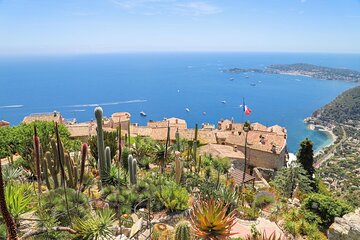
I sat and took it all in. The water’s sapphire blue blended with the cloudless azure sky, making it hard to see where one ended and the other began. Boats below me had been reduced to miniatures in the infinite horizon of blues. I had visited the Mediterranean before, but as I turned my head from side to side to take in her whole expanse, she looked different. Was this what Nietzsche meant when he described how this landscape had affected the Greeks? If I looked out upon this view every day, perhaps my eyes, my thoughts, my very nature would also be molded to value beauty above all else. Instead, my eyes have been warped, the lenses permanently disfigured by being in a world full of closed borders.

No doubt a modern-day Nietzsche will someday hypothesize about the greater effects that living through a pandemic has had on our culture. As I sat and gazed out, I was acutely aware of how my experience of the Mediterranean—waters I’ve viewed many times, and from the shores of numerous countries—was all the more precious now that I was living in a time when travel could so quickly be taken away.
I stood and made my way to the end of the trail. My sundress was soaked in sweat from top to bottom, and my legs quivered under my weight. I felt less like I’d completed a short but steep hike and more like I was emerging from a dance club into the early morning. Crowds pouring out of Èze, headed down the trail from the other direction, stopped me to ask about the length of the path and the terrain. I offered my fellow walkers smiles full of joy as I answered, welcoming them to the adventure. The route was short, cut centuries before, but today, heading out on the same path, we felt like revelers at a party two years in the making. New friends. “Come! It’s time, it’s time!” Nietzsche wrote. Yes, Nietzsche! It is time!
Find things to do on the French Riviera







Keep reading


