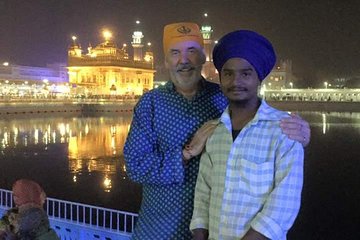
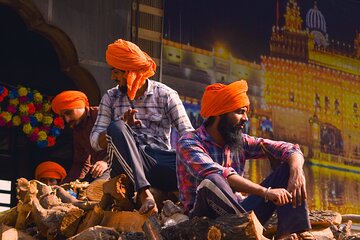
A view of the Sikh Golden Temple in Amritsar and its reflection in the surrounding pond

Things to do in  Amritsar

Sikh and ye shall find

As the capital of the Sikh religion, Amritsar in northwest India attracts people from all over the world to its Golden Temple. One of the religion's holiest places, the iridescent building covered in gold leaf feeds more than 40,000 pilgrims per day, free of charge. A major attraction nearby is the Wagah Border between India and Pakistan. Both country's militaries go to great lengths to outdo each other in their parades at the nightly closing of the border ceremony, and the atmosphere is carnivalesque.

Top 3 attractions in Amritsar

Top activities in Amritsar

All about Amritsar

Local Currency
Indian Rupee (₹)
When to visit

As in much of India, summer can get very hot in Amritsar. The city lies on the edge of the Great Thar Desert, so weather extremes are common. October through March, when temperatures are lower, is the prime time to visit. Summer temperatures have been known to reach 115°F (46°C). The monsoon usually hits between early July and early September.

Getting around

By Indian standards, Amritsar isn’t a large city, but its population still numbers well over a million people, so getting to places on foot can be tricky. It’s best to book excursions with a driver (especially if you’d like air conditioning), but for short journeys, flagging down a tuk-tuk is inexpensive and practical. There are cycle rickshaws as well as auto rickshaws.

Traveler tips

Make sure you bring cash. Many restaurants and small businesses in Amritsar won’t accept card payments. Try to keep small denomination notes to hand for tipping, which is common practice in India. Don’t scrimp on the food, Punjabi cuisine has a deservedly excellent reputation. Kulcha, a crispy paratha bread smeared with extra butter and eaten for breakfast, is a highlight, and forget about limiting your fat intake—this is the home of world-famous butter chicken.

en
0959455d-47ad-4e8d-b597-b888dd4f9390
attraction_list
People Also Ask
Q:What should I do with one day in Amritsar?
A:

Begin at Amritsar’s Golden Temple, the glittering Sikh holy place first constructed in the 16th century. In the afternoon, take a tour to the Wagah Border, where India and Pakistan meet. Watch the daily border closing ceremony, where the military from both sides parade and perform with pomp and splendor.

Q:What are the best things to see in Amritsar?
A:

Visit the Golden Temple—aim for evening, when an elaborate ceremony is performed to put the holy book, Guru Granth Sahib, "to bed." Not all Amritsar’s history is golden. In 1919 British forces opened fire on peaceful protesters at Jallianwala Bagh, and the massacre site is marked by a memorial.

Q:What is there to do in Amritsar at night?
A:

Amritsar is not a party town, but there are a few bars where you can unwind after sightseeing. The best night activity is to visit the Golden Temple. When it’s lit up, the reflections of the golden building in the temple pools are spectacular. The temple is open 24/7.

Q:Why is Amritsar called the golden city?
A:

Amritsar is called the golden city after its Golden Temple. The main temple structure is built from marble, and the building's upper half is covered with a whopping 882 pounds (400 kilograms) of gold leaf. It was built by the city’s Maharaja Ranjit Singh in the 16th century.

Q:How do I get to Amritsar?
A:

Amritsar has an international airport, serviced by Qatar Airways, which runs direct from Doha. Otherwise, international flights are limited, but domestic airlines have routes to other Indian cities, including Delhi, Mumbai, and Kolkata. Trains travel between Amritsar and Delhi, taking about six hours, the same as a private car transfer.

Q:When should I visit Amritsar?
A:

The optimal months temperature-wise are October, November, February, and March. In December and January, it’s not too hot, but mornings are often foggy, which can affect sunrise views of the Golden Temple and flight punctuality. Avoid summer, when temperatures soar and the monsoon hits.